

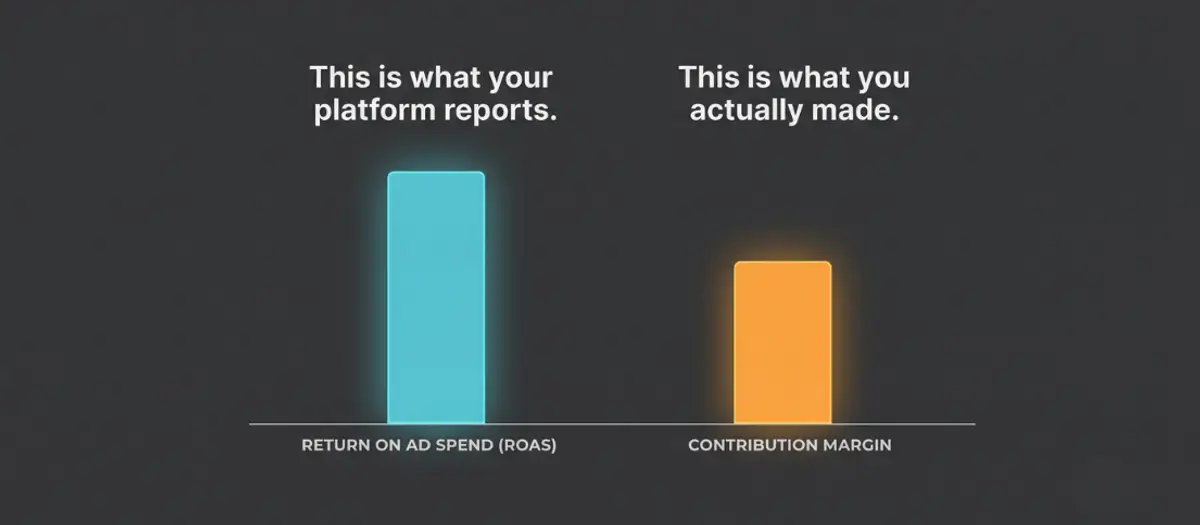
What your platform reports and what your business actually made are two different numbers. Many DTC ecommerce brands are optimizing for the wrong one.
Most DTC brands that plateau on paid media do not have a creative problem. They have an economics problem that looks like a creative problem.
The ROAS is holding. Spend is stable. But contribution margin is flat or declining. CAC keeps climbing. Each new creative cycle produces a shorter window of efficiency before the numbers drift again.
The natural response: better creative, more testing, a new agency. That is reasonable. It is also addressing the symptom. The structural failure is below the platform dashboard, and it is specific to how ecommerce businesses are built.
The Return Rate Is Destroying Your ROAS Before You See It
Platform ROAS is calculated on gross revenue. Returns happen after the conversion event. For most DTC categories, that gap is material.
Apparel brands typically return 25 to 40 percent of paid-media-driven purchases. Beauty and wellness commonly run 15 to 25 percent. Even outdoor and home goods, at 10 to 20 percent, are often enough to shift a reported 3x ROAS to a post-return 2.2x before you have touched COGS or fulfillment costs.
The platform does not know a customer returned the product. Its algorithm saw a conversion and attributed a purchase. It will optimize to repeat that customer profile. You are paying to acquire customers whose lifetime value, after returns, does not justify the CAC.
This is not a campaign setting you can adjust. It is a measurement gap. Until your attribution system knows what actually happened to the order, you are bidding on a signal that misrepresents your economics.
The First-Order Math Does Not Work. And the Algorithm Does Not Know.
Most DTC brands lose money on the first order. This is not a flaw in the model. It is the model. Customer acquisition is an investment: you spend more than the first order is worth because you expect a second order, and a third. That math only holds if customers come back.
Paid media algorithms are built to acquire first orders. They have no visibility into whether the customers they acquire return to purchase again. They cannot distinguish a customer who buys once and disappears from one who makes seven purchases over two years.
The brand paying $60 CAC to acquire a $55 first-order customer may be building real value or burning cash. The algorithm cannot tell. Neither can the team, unless they have connected acquisition data to purchase history and are tracking cohort LTV forward.
Most are not. Most are managing to a CAC target that was set when customer return rates, average order values, and cohort LTV all looked better than they do now. The business has changed. The targets have not.
Your Algorithm Is Optimizing for the Wrong SKUs
A DTC brand with 40 SKUs does not have 40 equal products. It has a handful of high-margin anchors and a longer tail of lower-margin volume items. The economics of growth depend on acquiring customers whose first purchase pulls them toward the high-margin end of the catalog.
Platform algorithms optimize for conversion volume. That means they will consistently route spend toward the products and audiences most likely to transact. Often, that means the lower-priced, lower-margin items that generate the most orders at the lowest friction.
The result: your campaigns drive volume. Contribution margin does not grow with it. Because the algorithm pushed spend toward the $38 item with a 4.2 percent conversion rate instead of the $120 item that would anchor the customer's purchase behavior toward the high-LTV segment of your catalog.
This is a structural misalignment between what the platform measures and what your business needs. Solving it requires either product-level bid adjustments, catalog segmentation by margin tier, or a measurement system that feeds actual margin data back into campaign decisions. None of those are default settings.
Hero Product Fragility Is the Real Ceiling
Almost every DTC brand's paid media scaling story has the same structure: one or two hero products drive the majority of paid performance. The entire growth model runs on those products converting at a rate that justifies the CAC.
When a hero product saturates its addressable audience, faces a new competitor, or drops conversion rate for any reason, the entire machine decelerates. Not because paid media stopped working. Because the growth system was concentrated in a single paid media winner without the catalog depth or cohort economics to sustain scale when that winner matures.
Paid media scale for a DTC brand should compound. New customer cohorts should expand the base of repeat purchasers. Catalog expansion should increase average order value and purchase frequency over time. When the model is working, adding spend adds customers who come back. When it is not, adding spend adds first-order transactions that do not compound into a business.
Most DTC brands are in the second category and do not know it until the hero product fades.
What Scaling Actually Requires
It starts with measurement. Not the platform's measurement: yours. Contribution margin by paid channel, after returns, after fully-loaded costs. Cohort LTV by acquisition source, tracked at 30, 90, and 365 days. The gap between what the platform reports and what the business actually earned.
Those numbers tell you whether you have a scaling problem or a structural one. Most teams, when they do this work, find the structural problem has been compounding for six to eight quarters before ROAS starts moving.
From there: align campaign structure with margin tier, not just conversion rate. Build a feedback loop from post-purchase data back into bidding and audience strategy. Stop setting CAC targets against first-order economics and start setting them against projected cohort LTV.
This is not a campaign management change. It is a growth system change. And it requires analytics infrastructure that sees your business, not just your ad accounts.
David Manela is co-founder of Exactius. Follow him on LinkedIn for more frameworks on growth, marketing, and capital allocation.
Exactius is a full-funnel growth agency accountable for its clients' P&L. Its AI-enabled senior operators provide performance marketing, strategy, creative, and whole-business analytics and data science, engaged one function at a time or as a full team. It serves consumer and B2B companies where paid marketing is a main growth lever, through two practices: one for companies from $5M to $100M and one for companies from $100M to $1B.
David Manela
David Manela is the founder of Exactius and creator of the Growth Operating System — a framework for deploying capital-efficient, compounding growth inside scaling companies.
FAQ
Frequently asked
Why does paid media stop scaling specifically for DTC ecommerce brands?
DTC brands face four structural failure modes that subscription or B2B businesses do not: return rates that erase reported ROAS after the fact, first-order economics that lose money on acquisition and only work if customers return, SKU mix misalignment where platform algorithms push spend toward high-conversion low-margin products, and hero product concentration that creates fragility when a single paid media winner matures. These are not campaign execution problems. They are structural gaps between what platform dashboards measure and what actually drives long-term profitability.
How do product return rates affect ROAS for DTC brands?
Platform ROAS is calculated on gross revenue at the time of purchase. Returns happen after the conversion event, and the platform never records them. For apparel brands with 25 to 40 percent return rates, a reported 3x ROAS can translate to a 2.0 to 2.2x ROAS on net revenue before factoring in COGS, fulfillment, or return-processing costs. The practical consequence: the algorithm optimizes toward customer profiles that convert at high rates but return at high rates, and you cannot see that misalignment in platform reporting without connecting return data to acquisition data.
What is first-order economics and why does it matter for DTC paid media?
First-order economics refers to the profitability of a customer's initial purchase, before any repeat purchases are considered. Most DTC brands spend more to acquire a customer than they earn on the first order, and that is a deliberate choice: the business only becomes profitable if that customer comes back. The problem for paid media is that acquisition algorithms optimize for first orders, not repeat purchases. They have no signal about whether customers return. So the algorithm is maximizing the metric that matters least (first conversions) while the metric that determines profitability (repeat purchase rate by cohort) goes unmeasured and unmaintained.
How should a DTC brand set CAC targets for paid media?
CAC targets should be set against projected cohort LTV, not first-order revenue. The right CAC limit for a channel is the point at which the 12-month LTV of customers acquired from that channel, discounted to present value, produces an acceptable LTV:CAC ratio given your working capital constraints and payback window. Most brands set CAC targets based on gross margin at first purchase, which systematically undervalues channels that acquire high-repeat customers and overvalues channels that acquire high-AOV single-purchasers. Recalibrate by connecting acquisition source data to 365-day purchase history, segmenting cohorts by channel, and setting targets channel by channel.
What analytics infrastructure does a DTC brand need to scale paid media profitably?
Four connections are required. First, a link between ad platform conversion data and post-purchase order data that accounts for returns, so contribution margin by channel can be calculated after fulfillment and return costs. Second, a customer-level identifier that ties acquisition source to all subsequent purchase events, enabling cohort LTV tracking by channel and campaign. Third, a margin-tier classification at the SKU level that can feed into campaign bidding logic, either through custom signals or manual campaign segmentation. Fourth, a dashboard that surfaces cohort LTV:CAC by acquisition channel over time, not just current-period ROAS. Without these four pieces, a DTC brand is making capital allocation decisions on incomplete information.
Related Reading
Keep going



Ready to fix the system?
Your growth system is either compounding or degrading.
Book a diagnostic call. We'll identify where your growth system is breaking and what it's costing you.