

Why Paid Media Campaigns Stop Scaling in 2026
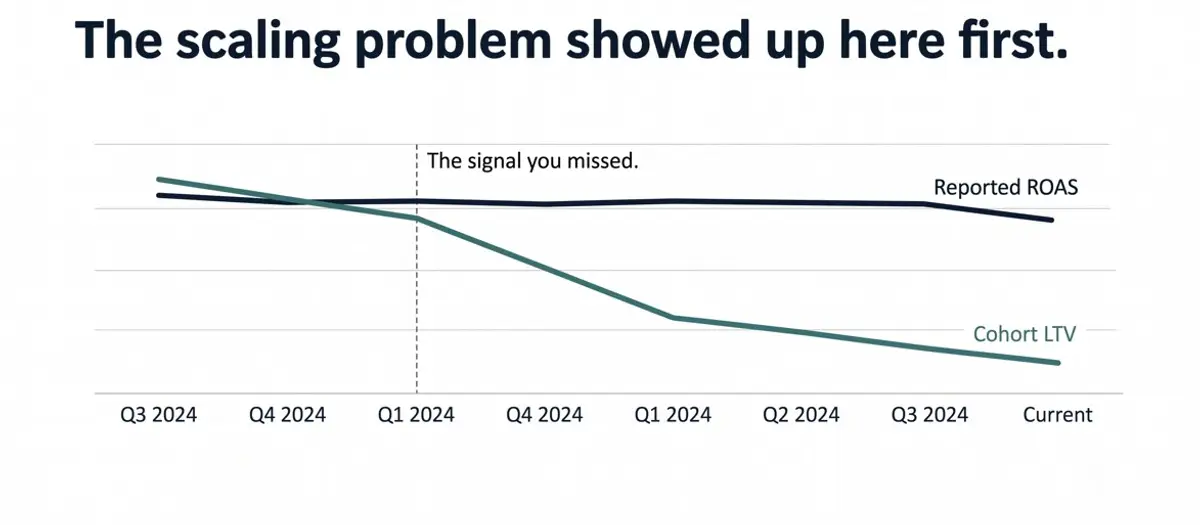
Reported ROAS stayed flat while Cohort LTV was falling for six quarters. The scaling problem was visible in the data long before it showed up in the budget conversation.
The team tried new creatives. Then new audiences. Then a new agency. The ROAS kept declining.
This is the pattern that shows up in almost every paid media review I sit in. The diagnosis is usually the same — creative fatigue, audience saturation, increased competition — and the fix is usually the same: iterate faster, test more, spend differently.
Those are real problems. They're also symptoms, not causes.
In 2026, the structural conditions that allow paid media to scale have shifted in ways most teams are still treating as execution problems. The teams that figure this out early are capturing market share from the ones still running the 2022 playbook.
The Signal That Used to Guide You Is Gone
Paid media optimization was, for most of the last decade, a feedback loop. You spent money, measured what converted, fed that signal back into the algorithm, and the algorithm compounded over time — better targeting, better bidding, better allocation. The loop worked.
That loop is broken.
iOS 14 started the unraveling in 2021. Cookie deprecation, platform privacy changes, and walled gardens getting more walled have continued since. In 2026, the average DTC or subscription brand is operating with 40–60% of the conversion signal they had three years ago — and that's the optimistic estimate.
The algorithm is still optimizing. It's just doing it with less data. And in many cases, it's filling the signal gap with proxy signals that don't correlate cleanly with your actual business outcomes — optimizing for conversions that look like purchases to the platform, not necessarily profitable customers for your business.
The result: campaigns that look like they're working on platform dashboards but aren't generating the contribution margin cohorts your attribution report implies.
Creative Differentiation Has a Shorter Half-Life
Three years ago, a strong creative concept could hold for weeks. Sometimes months. In 2026, that window has compressed — driven by AI-generated creative flooding every major auction, UGC-style formats becoming so saturated they've lost the authenticity signal they once carried, and algorithms that surface winning creative formats to competitors faster than ever before.
You find something that works. Then, faster than ever, everyone else finds something that looks similar.
This isn't an argument against testing. It's an argument against treating creative testing as your primary scaling lever. When differentiation has a shorter shelf life, the answer isn't just faster iteration — it's building creative assets that have structural advantages competitors can't replicate from a prompt: proprietary proof points, real customer relationships, earned brand credibility, owned distribution that compounds over time.
Creative velocity without that foundation is a treadmill. Not a flywheel.
The Platforms Removed Your Leverage
Google Performance Max and Meta Advantage+ share the same fundamental premise: let the algorithm run the campaign, and it will outperform human optimization. For most advertisers, most of the time, this is probably true.
But it comes at a cost that scaling teams don't account for until too late.
When the platform controls targeting, creative rotation, placement, and bidding — and returns limited visibility into which inputs are actually moving the output — you lose the ability to diagnose why performance is changing. You see ROAS and CPAs. You don't see what's driving them.
Performance Max will cannibalize branded search traffic and attribute it as incremental. Advantage+ will allocate budget toward what converts most easily, not what generates your best LTV cohorts. Both are optimizing for the platform's definition of success — which is not the same as yours.
The Real Scaling Ceiling
The teams that reliably scale paid media share something that has nothing to do with platform sophistication or creative volume.
They measure at the right level.
They don't optimize for platform ROAS. They optimize for contribution margin by channel and cohort-level LTV:CAC by acquisition source. They know, with reasonable confidence, whether a dollar deployed in each channel is creating more than a dollar of long-term value — after fully-loaded costs, not just media costs.
Most teams aren't. They're optimizing for platform efficiency metrics inside campaigns that are, at the business level, producing customers with lower lifetime value than they were 18 months ago. The ROAS looks fine. The cohort data tells a different story.
The Fix Isn't More Spend or Better Creative
It's a measurement problem first. Then an attribution problem. Then — and only then — a creative and channel strategy problem.
Start by pulling contribution margin by paid channel. Find the gap between what the platform reports and what the business actually earned after fully-loaded costs. Then pull 12-month LTV by acquisition channel and look at how it has trended over the last four to six quarters.
What you will almost always find: the scaling problem started earlier than the ROAS decline. It showed up in cohort quality first — lower LTV, higher early churn, worse product attachment — before it surfaced as campaign-level efficiency degradation. By the time your ROAS starts moving, you've usually been compounding the problem for two or three quarters.
Fix the measurement. Then diagnose the cause. Then test the fix.
In that order.
David Manela is co-founder of Exactius, a growth and data science company. Follow him on LinkedIn for more frameworks on growth, marketing, and capital allocation.
David Manela
David Manela is the founder of Exactius and creator of the Growth Operating System — a framework for deploying capital-efficient, compounding growth inside scaling companies.
FAQ
Frequently asked
Is the paid media scaling problem specific to 2026, or has it always existed?
The underlying dynamics — creative fatigue, audience saturation, rising competition — have always existed. What's structurally different in 2026 is the compounding of three forces simultaneously: signal loss from privacy changes has matured to a point where optimization algorithms are running on significantly less conversion data; AI-generated creative has dramatically shortened creative differentiation cycles; and platform black-boxing through Performance Max and Advantage+ has reduced the human leverage that sophisticated teams previously used to outperform.
How much paid media conversion signal have we actually lost since iOS 14?
Most DTC and subscription brands running primarily through Meta and Google are operating with 40–70% of the conversion signal they had in 2020–2021. Signal loss is not uniform — upper-funnel awareness channels are less affected than lower-funnel conversion campaigns, and brands with strong first-party data infrastructure have recovered more than those still relying primarily on pixel-based tracking.
Should we stop using Performance Max and Advantage+ if they limit visibility?
Not necessarily — for most advertisers, broad automated campaign types outperform tightly controlled manual campaigns on pure conversion efficiency. The problem isn't using them; it's using them without guardrails. Protect branded terms from Performance Max cannibalization using brand exclusions. Use audience signals to steer Advantage+ toward the customer type you want. Run incrementality tests periodically to verify that conversions the platform claims are actually incremental.
What's the earliest signal that paid media is about to stop scaling — before ROAS declines?
Cohort-level LTV degradation is almost always the leading indicator. Before ROAS starts declining at the campaign level, you'll typically see the 90-day LTV of customers acquired through paid channels trending downward — lower second-purchase rates, higher early churn, worse product attachment. This shows up in your cohort analysis 3–6 months before it surfaces in platform dashboards.
How do you scale paid media profitably in a signal-constrained, AI-saturated environment?
Three disciplines matter more in 2026 than they did three years ago. First, invest in first-party data infrastructure — email capture, post-purchase surveys, loyalty mechanics — so your signal quality improves relative to competitors. Second, shift creative investment toward assets with structural differentiation: owned proof points, real customer stories, earned credibility that can't be generated from a prompt. Third, measure at the business level — contribution margin by channel and LTV by acquisition cohort, reviewed monthly, tied directly to budget allocation decisions.
Related Reading
Keep going



Ready to fix the system?
Your growth system is either compounding or degrading.
Book a diagnostic call. We'll identify where your growth system is breaking and what it's costing you.