

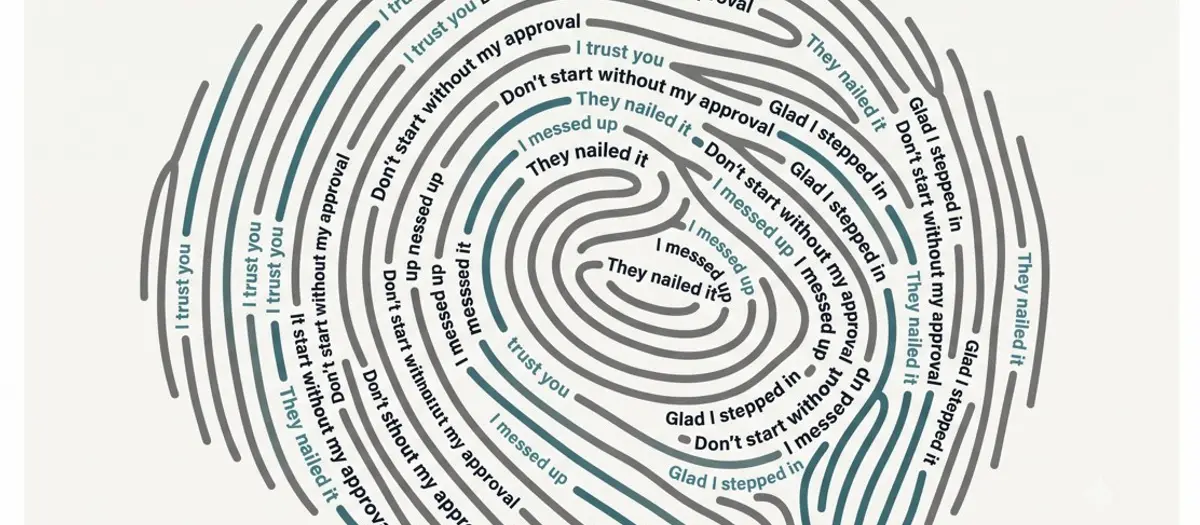
Your leadership style isn't in your values deck. It's in the phrases you reach for when the pressure is on.
The fastest way to spot a micromanager isn't their org chart. It's their vocabulary.
You can restructure reporting lines, flatten hierarchies, and preach empowerment all you want. The leadership style that actually reaches your team is the one that lives in the phrases you reach for when things get complicated.
I've managed teams of 120 people across multiple organizations. And the clearest signal I've found — the one that shows up before any engagement survey, before any attrition spike — is language.
The words a leader defaults to in pressure moments are a direct print of their actual operating model. Not their stated values. Not their principles deck. The thing they say when the deadline is tomorrow and the numbers aren't where they need to be.
Micromanagers believe control creates results. Growth leaders know trust creates velocity. Both are coherent philosophies. They just produce very different organizations.
Where the Gap Shows Up
The divide lives in five specific moments that every manager navigates constantly.
When delegating, the micromanager says: "Don't start without my approval." They mean well — they want visibility, they want to catch problems early. But what the team hears is: your judgment can't be trusted. Over time, that message compounds. People stop bringing half-formed ideas. They wait. They ask permission. The manager ends up with a team that can only move when triggered.
The growth leader says: "I trust you." And means it. They establish context, not checkpoints. They're available without being required.
When things go wrong, the micromanager's default is distance: "I had nothing to do with that." They're protecting themselves, but they're signaling to the team that failure is unsafe — something to hide or deflect. The next time something goes sideways, the instinct is to cover it rather than surface it.
The growth leader says: "I messed up." Even when it's shared accountability. The message this sends — that failure is information, not a verdict — is worth more than any post-mortem framework.
When teams succeed, the micromanager says: "Glad I stepped in." Even when the win was almost entirely the team's work, the credit gets absorbed upward. People notice. They don't stop working hard, but they stop bringing their best. The energy that goes into innovation quietly gets redirected into self-preservation.
The growth leader says: "They nailed it." Publicly. Specifically. Without qualification.
The Compounding Effect Nobody Talks About
The reason these patterns matter isn't any single conversation — it's what compounds over six months of them.
Under a micromanager, teams develop a specific set of habits: waiting for approval before moving, hedging recommendations with excessive caveats, running small decisions up the chain that should never require sign-off. The manager spends more and more time on things that shouldn't require their involvement. The team gets slower. The manager works harder. Everyone is exhausted and nobody knows why.
Under a growth leader, the opposite compounds. People start making decisions they used to escalate. They start owning outcomes they used to share. The manager gets pulled into fewer operational details and more strategic questions. The team gets faster. Trust generates more trust.
This is the paradox: the more control you demand, the less effective leverage you have. The more trust you give, the more you can actually influence.
A Test Worth Running
If you want to audit your own defaults, don't start with your intentions — start with your last ten team interactions. What did you actually say when someone came to you with an uncertain decision? When a project missed a deadline? When a team member closed a win?
The patterns are there. They're reproducible. And they're telling you something about the organization you're building whether you're paying attention or not.
Growth leaders aren't defined by what they would say in ideal conditions. They're defined by what they do say when the stakes are real and the moment is fast.
David Manela is co-founder of Exactius, a growth and data science company. Follow him on LinkedIn for more frameworks on growth, marketing, and capital allocation.
David Manela
David Manela is the founder of Exactius and creator of the Growth Operating System — a framework for deploying capital-efficient, compounding growth inside scaling companies.
FAQ
Frequently asked
How can you tell if a leader is a micromanager?
Listen to the phrases they use under pressure. In David Manela's experience, the language a leader reaches for when a deadline is close shows their real operating model more clearly than stated values or the org chart. Micromanagers say things like "Don't start without my approval" and "Glad I stepped in." Growth leaders say "I trust you" and "They nailed it."
How much does a manager affect team engagement?
A great deal. Gallup's State of the American Manager research, published in 2015, found that managers account for at least 70 percent of the variance in employee engagement scores. That makes a manager's default habits, including how often they step in, one of the biggest factors in whether a team is engaged or simply compliant.
What is psychological safety, and how does micromanagement affect it?
Amy Edmondson's 1999 study in Administrative Science Quarterly defines team psychological safety as a shared belief that the team is safe for interpersonal risk taking. In her study of 51 work teams, psychological safety was linked to learning behavior, which in turn drove performance. Responses that make failure unsafe, such as distancing yourself from a mistake, work against that belief.
What do growth leaders say differently from micromanagers?
When delegating, a growth leader says "I trust you" and sets context in place of checkpoints, while a micromanager requires approval before work starts. When something goes wrong, the growth leader says "I messed up," even when accountability is shared. When the team succeeds, the growth leader says "They nailed it" publicly, while the micromanager absorbs the credit with "Glad I stepped in."
How can a manager audit their own leadership style?
Review your last ten team interactions and note what you actually said. Look at how you responded when someone brought you an uncertain decision, when a project missed a deadline and when a team member closed a win. Those patterns are reproducible, and they show the kind of organization you are building. Leaders are defined by what they say when the stakes are real.
Why are so many managers ineffective?
Often because the wrong people are put in the role. Gallup reports that companies fail to choose the candidate with the right talent for the manager job 82 percent of the time, and estimates that about one in ten people have the natural talent to manage well. That makes manager selection and coaching as important as any change in a leader's vocabulary.
Related Reading
Keep going

Ready to fix the system?
Your growth system is either compounding or degrading.
Book a diagnostic call. We'll identify where your growth system is breaking and what it's costing you.