

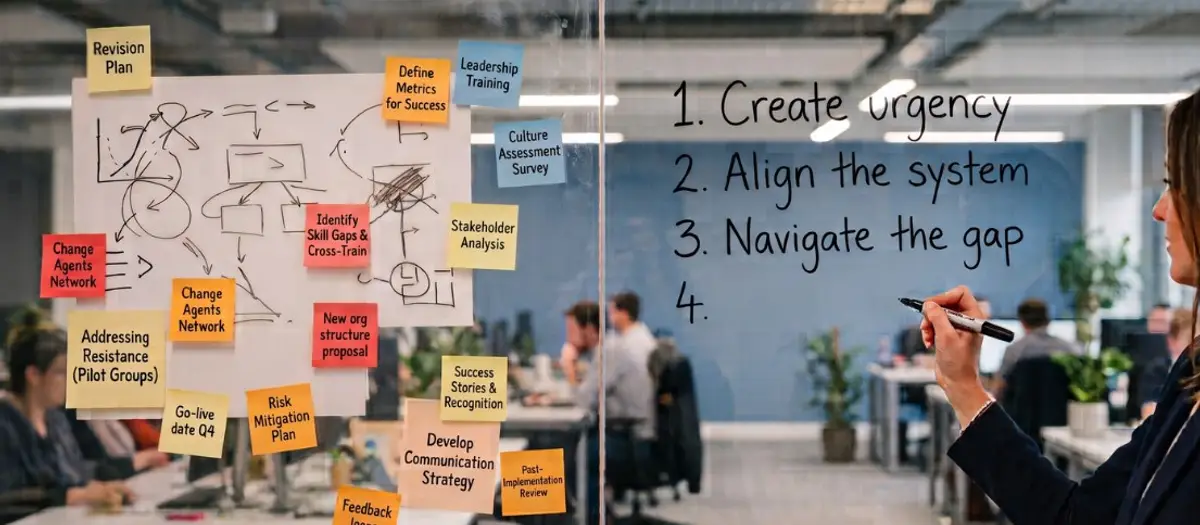
Most change initiatives fail not because the plan was wrong — but because no one ran it with structure.
Most companies don't fail at strategy. They fail at implementation. And nowhere is that gap more visible than when someone announces a change.
Here's the pattern I've seen too many times: a new plan gets announced with energy, tasks get assigned, everyone gets busy: and six weeks later, nothing has fundamentally changed. The meetings still follow the old format. The metrics still reflect the old goals. The team reverts to what they knew.
The problem isn't commitment. It's that change without structure is just chaos with a deadline.
Teams that implement change effectively don't rely on motivation or willpower. They use frameworks: specific, repeatable systems that move people from the old state to the new one, and make the new thing normal. Here are four that work.
1. Kotter's 8-Step Model
Best for: major GTM shifts or platform migrations
Kotter's model maps the full arc of organizational changE: from creating urgency to anchoring new behaviors in culture. The mistake most teams make is trying to run an 8-step model across a 6-month roadmap. Compress it. Run each step in 30-45 day sprints.
The critical insight in Kotter is that you need to generate visible short-term wins before momentum is real. If people don't see progress by week six, they start reverting. Build quick wins deliberately into the plan: they're not incidental, they're the mechanism that keeps the initiative alive long enough to take root.
2. McKinsey's 7S Framework
Best for: understanding why past changes failed
Before launching the next initiative, run this as a Day 1 diagnostic. The 7S model maps seven interdependent elements of an organization: Strategy, Structure, Systems, Shared Values, Style, Staff, and Skills. If strategy, systems, and skills aren't aligned, stop. You don't have a change initiative, you have a wishlist.
The most common failure pattern: companies change the strategy and the systems, but leave the skills and shared values untouched. Then they wonder why the new direction isn't being executed. The 7S model tells you exactly where the gap is before you spend six months finding out the hard way.
3. Bridges' Transition Model
Best for: team reorganizations or role changes
Bridges makes a crucial distinction most change management skips: there's a difference between change (the external event) and transition (the internal psychological journey). You can implement a change in a week. The transition takes much longer.
The model has three stages: Ending, Neutral Zone, New Beginning. Most failures happen in the Neutral Zone: the uncomfortable middle where the old way is gone but the new way isn't yet clear. People in the Neutral Zone lose momentum, make conservative decisions, and quietly resist. The job of leadership during this phase is to provide clear direction and evidence of progress, even when things feel ambiguous.
4. Lewin's 3-Step Model
Best for: process changes that need to become habit
Unfreeze. Change. Refreeze. Lewin's model is deceptively simple, and the most commonly botched. Teams focus almost entirely on the Change step. They redesign the process, retrain the team, and update the tools. Then they move on to the next initiative.
But without the Refreeze, the deliberate effort to lock the new behavior into routine, nothing sticks. Old habits creep back. The change evaporates. Refreezing means creating accountability structures, updating performance metrics to reflect the new process, and recognizing the teams doing it right. It's not a celebration of the launch. It's the work that makes the launch permanent.
Pick One and Run It With Discipline
The best change management framework is the one your team actually uses. The worst outcome is picking all four and running none of them properly. Choose the one that fits the type of change you're managing, give someone ownership, and execute it with the same rigor you'd apply to a product launch.
Change is easy to announce. The real work is making the new thing feel normal. And eventually, inevitable.
David Manela
David Manela is the founder of Exactius and creator of the Growth Operating System — a framework for deploying capital-efficient, compounding growth inside scaling companies.
FAQ
Frequently asked
Why do change initiatives fail?
Most fail in implementation. McKinsey reported in 2015 that 70 percent of change programs fail to achieve their goals, largely because of employee resistance and a lack of management support. A plan gets announced and tasks get assigned, but without a structure to move people from the old way of working to the new one, meetings and metrics drift back to what they were.
What are the 8 steps in Kotter's change model?
Kotter's steps, as Kotter Inc. lists them, are: create a sense of urgency, build a guiding coalition, form a strategic vision, enlist a volunteer army, enable action by removing barriers, generate short-term wins, sustain acceleration, and institute change. The model comes from John Kotter's book Leading Change. The author of this post suggests running each step in 30 to 45 day sprints.
What is the McKinsey 7S framework?
The 7S framework is a diagnostic that maps seven interdependent elements of an organization: strategy, structure, systems, shared values, style, staff and skills. McKinsey says it was introduced in the late 1970s and featured in In Search of Excellence by former McKinsey consultants Tom Peters and Robert Waterman. It is useful for finding why a past change failed before launching the next one.
What is the difference between change and transition in the Bridges model?
In Bridges' Transition Model, change is the external event and transition is the internal psychological adjustment people go through. A change can be implemented in a week, while the transition takes much longer. The model has three stages: Ending, Neutral Zone and New Beginning. Most failures happen in the Neutral Zone, where leaders need to give clear direction and evidence of progress.
What does the refreeze step in Lewin's change model involve?
Lewin's model has three steps: unfreeze, change and refreeze. Teams often focus on the change step and move on, so old habits creep back. Refreezing is the deliberate effort to lock the new behavior into routine. It means creating accountability structures, updating performance metrics to reflect the new process and recognizing the teams doing it right.
Which change management framework should a company choose?
Choose the one framework that fits the type of change you are managing and run it with discipline. Kotter suits major go-to-market shifts, 7S suits diagnosing past failures, Bridges suits reorganizations and role changes, and Lewin suits process changes that need to become habit. Picking all four and running none of them properly is the worst outcome. Give one person ownership of it.
Related Reading
Keep going

Ready to fix the system?
Your growth system is either compounding or degrading.
Book a diagnostic call. We'll identify where your growth system is breaking and what it's costing you.