

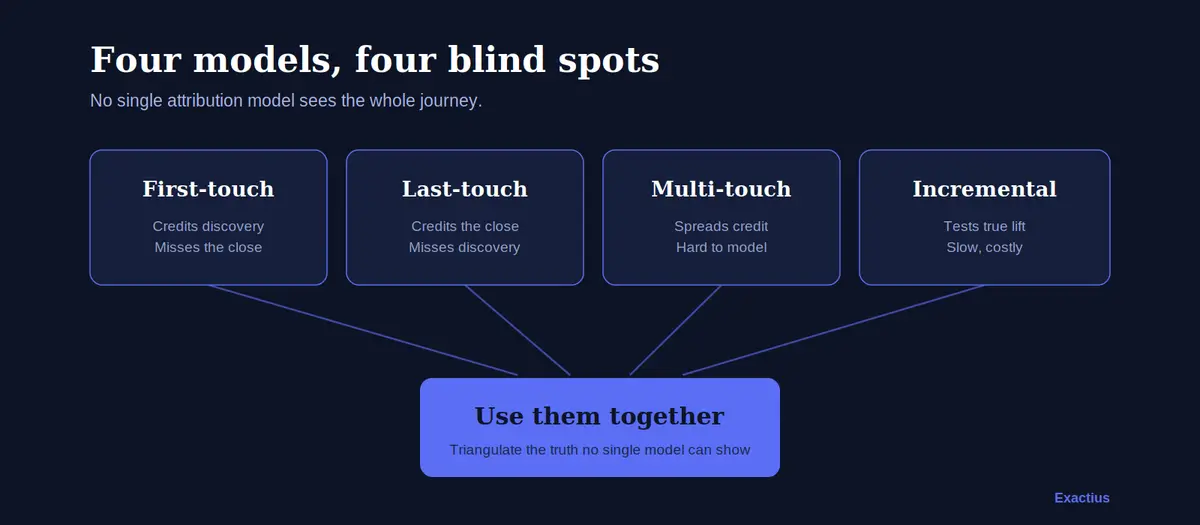
Comparison of Marketing Attribution Models
Most growth conversations about attribution eventually become arguments about which model is correct. First-click versus last-click. DDA versus Shapley value. MMM versus MTA. The debate runs in circles, not because everyone is wrong, but because they're each defending an answer without first agreeing on the question.
The smartest teams don't pick the "right" attribution model and commit to it. They pick the right model for the decision they're currently making — and they triangulate across multiple lenses to validate what they're seeing. The goal isn't a perfect single source of truth. It's faster, better-informed decisions.
When You Need a Fast, Consistent Signal
Last-click and first-click attribution — UTM-based, platform-native — are the right tools when you need a daily or weekly pulse check on what's happening in the funnel. They're instant, consistent, and simple enough for any team member to read and act on.
Their limitation is structural: they credit one touchpoint for a conversion that was almost certainly influenced by several. Last-click will always overweight the final interaction — typically paid search or retargeting — at the expense of channels that created the intent. First-click overstates the role of awareness. Neither tells you what's actually driving conversions; they tell you what was last (or first) to touch them.
Used as a directional instrument for operational decisions — budget pacing, creative rotation, daily anomaly detection — they work. Used for strategic channel allocation, they mislead.
When You Need to See What Last-Click Misses
Multi-touch attribution — DDA, model-based approaches, Shapley value — distributes credit across every touchpoint in the conversion journey using impression or click-level data. This is where it becomes genuinely useful for channels like display, native, paid social, and YouTube, where the conversion signal is indirect or delayed.
The goal with MTA is to select an approach that minimizes data collection infrastructure while maximizing decision value. When properly implemented, it reveals which channels are doing work that last-click attribution systematically misses — and that insight unlocks investment in channels your current model is under-crediting.
The tradeoff is complexity. MTA requires clean impression data, a reliable identity layer, and enough volume to make the model statistically meaningful. It also doesn't handle offline or broad-reach media well — which is where the third tool becomes essential.
When You're Making Budget Calls That Last
Marketing Mix Modeling operates at a different altitude. It's an econometric model built across your full media mix — TV, out-of-home, offline channels, brand spend, and digital — using aggregate data over an extended period. It doesn't track individual touchpoints; it measures the marginal impact of spend at the portfolio level.
MMM takes longer to build and requires more historical data than the other models. But it reveals pockets of efficiency that channel-level attribution can't reach: the incremental contribution of brand investment, the interaction effects between channels, the marginal return on the next dollar in each medium.
For any company running meaningful spend on broad-reach media, MMM isn't a sophisticated add-on. It's the only model that can give you a clear view of what that spend is actually contributing.
Triangulate, Don't Arbitrate
No single model tells the whole truth. Each one answers a specific question well — and answers others poorly. The teams that win on measurement aren't the ones with the most sophisticated model; they're the ones who have matched the right tool to the right question.
The most rigorous approach combines all three: last-click or first-click for operational monitoring, MTA for channel-level investment decisions, and MMM for portfolio-level budget allocation. Incrementality testing — geo-holdouts, matched market tests, conversion lift studies — sits above all three as the validation layer that calibrates each model against actual causal effects.
Choose your attribution model based on the decision you need to make, not the theory you find most elegant. The output is better decisions, not a winning argument in a quarterly planning meeting.
David Manela is co-founder of Exactius, a growth and data science company. Follow him on LinkedIn for more frameworks on growth, marketing, and capital allocation.
David Manela
David Manela is the founder of Exactius and creator of the Growth Operating System — a framework for deploying capital-efficient, compounding growth inside scaling companies.
FAQ
Frequently asked
How do last click and last touch attribution models differ in marketing analytics?
Both models give all of the credit for a conversion to the final interaction before it. The difference is what counts as that interaction. Last click credits only the final click, while last touch is the broader term and, depending on the tool, can also credit a direct visit or an ad view. Google's GA4 documentation shows the effect: its paid and organic last click model ignores direct visits unless the whole path is direct.
Which attribution models does Google Analytics 4 still offer?
Google's GA4 documentation lists three: data-driven attribution, paid and organic last click, and Google paid channels last click. First click, linear, time decay and position-based models were removed from GA4 as of November 2023. Google Ads stopped offering them for conversion actions in 2023 and moved remaining actions to data-driven attribution. Teams that want a first-click view in Google's tools now need to build it from their own UTM or CRM data.
What is data-driven attribution?
Data-driven attribution uses a statistical model of your conversion paths to split credit across touchpoints instead of following a fixed rule. Google's documentation says its version weighs time from the key event, device type, number of ad interactions, the order of ad exposure and the type of creative asset, and that conversions can be reattributed for up to 7 days afterward. Its output is only as reliable as the path data behind it.
What is Shapley value attribution?
Shapley value attribution splits credit for a conversion according to each channel's average marginal contribution across the combinations of channels that appear in conversion paths. The method comes from cooperative game theory: economist Lloyd Shapley introduced it in 1953 and later shared the 2012 Nobel Memorial Prize in Economic Sciences. In marketing it needs a large volume of path data to produce stable results.
What tools can a company use to build a marketing mix model?
Two free, open-source options come from the ad platforms themselves. Google made Meridian, its open-source marketing mix model, available to everyone in January 2025, with a program of certified measurement partners to help implement it. Meta Marketing Science publishes Robyn, which it describes as an experimental open-source MMM package. Both need several periods of clean spend and sales history to produce credible estimates.
How does incrementality testing relate to attribution models?
Attribution assigns credit for conversions that happened. Incrementality testing measures how many conversions the ads caused by comparing an exposed group with a control group that did not see them. Google's Conversion Lift offers user-based and geography-based studies, and Google notes it is not available in every account and is requested through an account representative. Lift results can then calibrate what MTA and MMM report.
Related Reading
Keep going


Ready to fix the system?
Your growth system is either compounding or degrading.
Book a diagnostic call. We'll identify where your growth system is breaking and what it's costing you.